
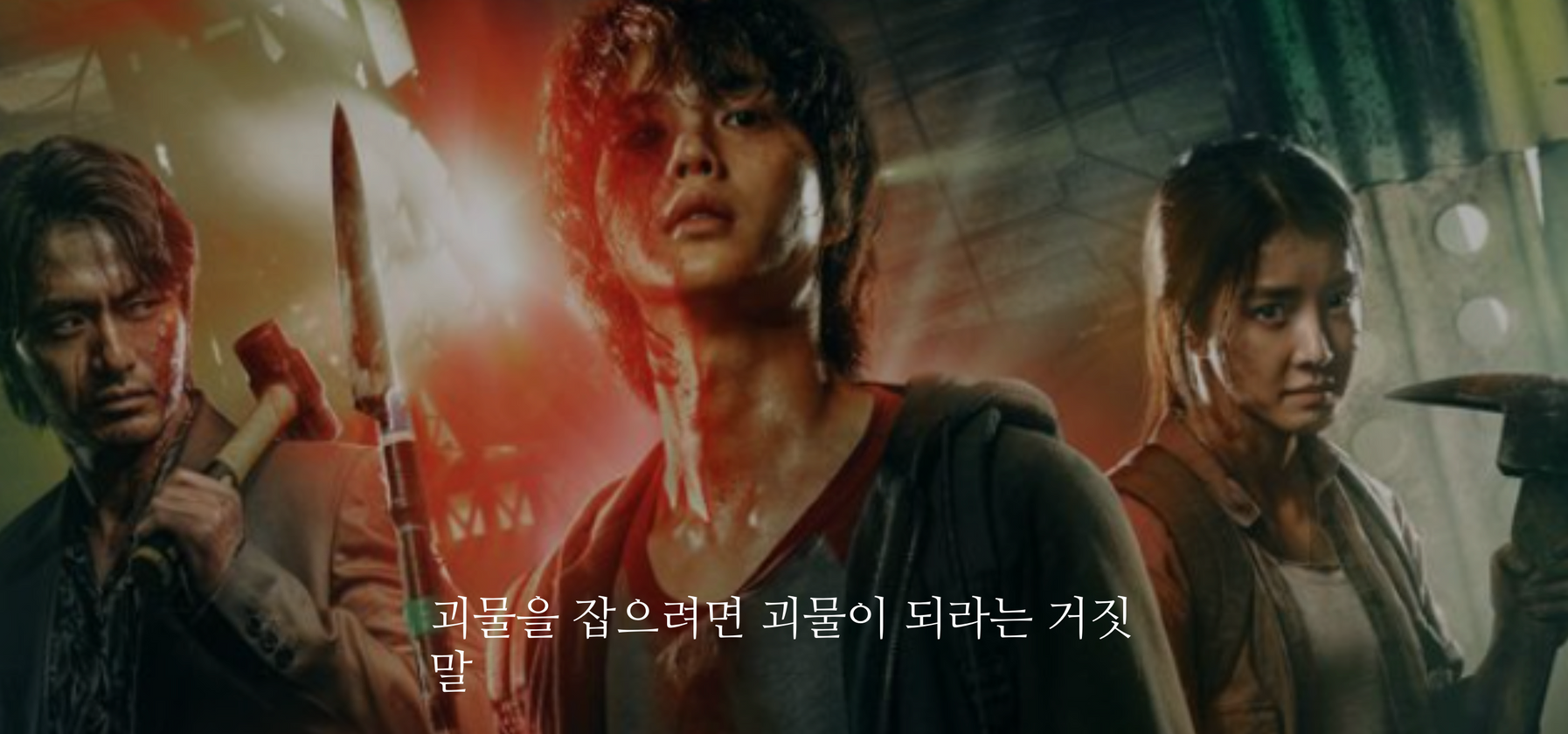
You must become stronger.
If you become weak-hearted by showing mercy, you will lose things that are more precious.
Because the world is cruel.
You must become a greater demon to catch a demon.
Not all monsters are bad… there might be good monsters…
This is a narrative that has been appearing increasingly in movies and dramas recently. It often appears after a scene where a character, having shown mercy and spared someone, is subsequently betrayed when that person reveals their true colors and takes the lives of the protagonist’s family, friends, or loved ones. Grieving the death of their loved ones with tears of blood, the protagonist hardens their heart, discards unnecessary(?) mercy, and decides to become a monster. They then gain the power of a mysterious destroyer, using their monstrous abilities to beat the bad guys to a pulp and achieve victory. It’s a story development that has become a cliché.
“You must become a monster to catch a monster…” It sounds plausible. If one becomes a greater monster than the monster, they should be able to defeat it. But what about the protagonist who becomes the greatest monster in the process? The audience, thanks to various storytelling emotional appeals, may side with the protagonist and feel catharsis, but that’s just an emotional deception.
The protagonist, now a monster, attacks the enemy’s headquarters. In the process, they casually kill the enemy’s new recruit who was standing guard, having just started that day. Among the key accomplices of the bad guys, there might be people who are forced to cooperate due to being blackmailed or threatened with harm to their families, but they are nevertheless blown up with bombs for the sake of catharsis. Is the victory achieved in this way truly a victory?
What remains after wiping out all the bad guys? Only the protagonist who has become a monster. In the end, the story is about the process of a human turning into a monster, and all the various unjust suffering, romance, and emotional appeals shown in between are merely devices to justify becoming a monster. If the protagonist had appeared as a monster from the beginning without all these devices, they would have clearly failed to gain the audience’s sympathy.
Whether they are on our side or the enemy’s, people have their own stories and circumstances. But if we are deceived by the dramatic devices that justify the appearance of a monster, the bad guys become targets that must be killed, and the monster becomes a godlike hero. It is a lie completed by weaving together human emotional reactions.
To deliver a fair judgment on who should live and who should die, one must have a godlike ability to see through every individual’s life story and even their innermost thoughts. This is not something that a mere human, turned into a monster by anger over the death of a loved one, can do.
Considering the limitations of humans, a true hero is someone who refuses to become a monster and, by sacrificing their own life to uphold conscience and justice, instills courage in other people who witness their actions to do the same. It is someone who lives with a clear conscience until death, without succumbing to any temptation or threat. It is someone who never stops loving others as themselves.
The temptation to become a monster, to become a superhuman through genetic manipulation, to become transhuman and wield superhuman power, is becoming increasingly prevalent and is expected to worsen in the future. But the more the media is filled with such content, the effect of capturing public attention will diminish. Perhaps a work with the following theme could create a stir:
“I will fight the monster to the end. But I will never become a monster myself. Even if it means death.”
Leave a Reply