
The movie Minority Report features the concept of “Thought Police” who preemptively punish future crimes that have not yet occurred. This is done by three oracles symbolizing the goddess Mago (the Korean mythology equivalent of a triple goddess), who predict future crimes through visions, searching the thoughts in the minds of potential criminals like big data.
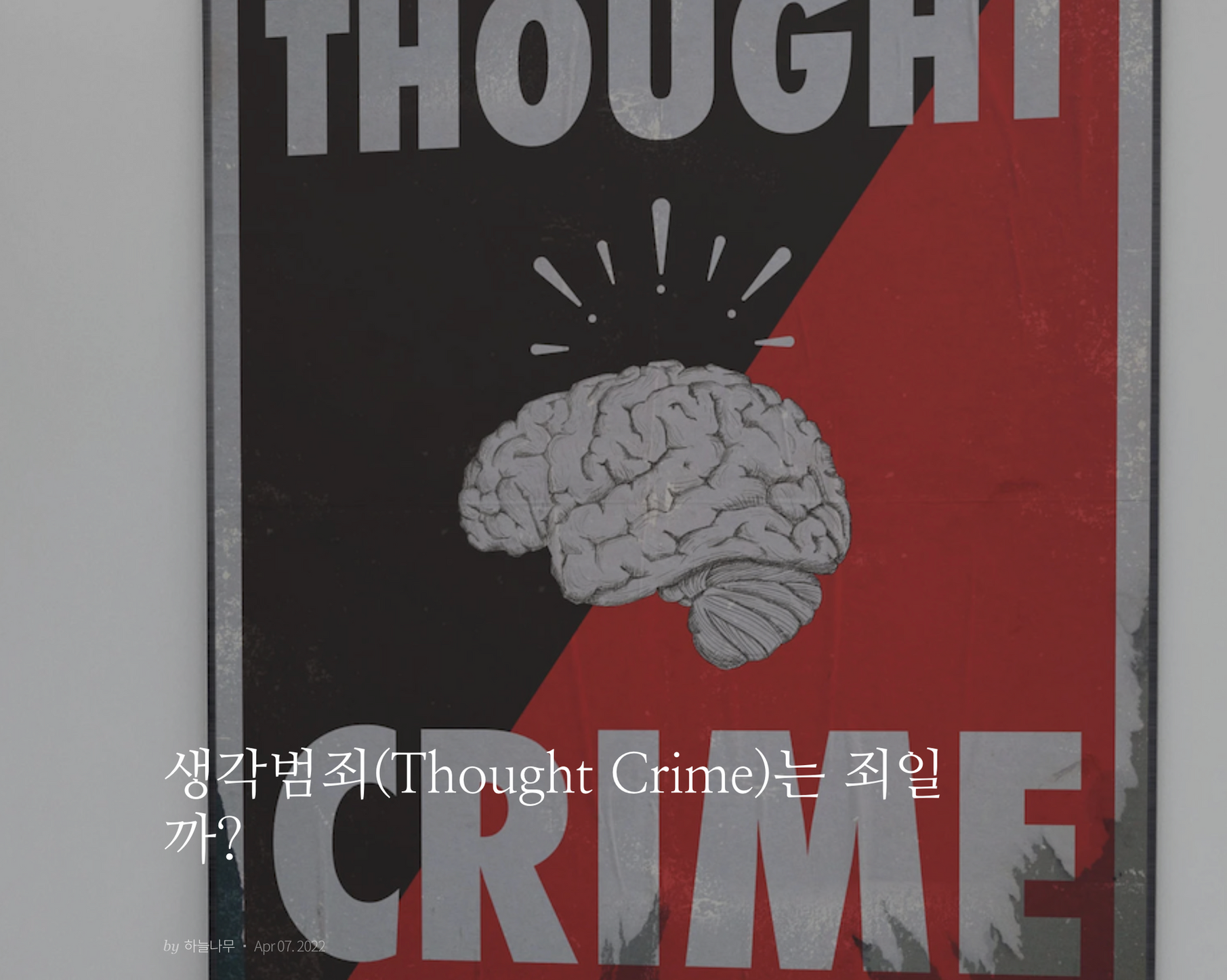
George Orwell’s famous novel 1984 features a similar concept. Not only actions against Big Brother but also words and even thoughts are subject to punishment. In order to prevent people from even thinking of rebelling against the government, they change the meanings of words or even eliminate certain words themselves.
Punishing thought crime like this is not just something in novels or movies. Communist countries that arrest people for criticizing the head of state or the government, and countries where freedom of religious choice is not allowed, can be seen as criminalizing and punishing certain thoughts. Therefore, they are characterized by pursuing a thorough surveillance society to find out people’s thoughts.
Interestingly, however, the Christian Bible, which emphasizes human freedom, contains content that acknowledges thought crime. Jesus Christ himself said that “adultery is established even by lustful thoughts, and even being angry is already murder.” The Bible clearly states that sins committed in thought are the same as sins committed in action. Can thoughts really become sins?
There is one commonality among all crimes. Before they are actually carried out, they are inevitably first conceived in the mind in the form of thoughts. Even accidental crimes are moved to action after going through the mind. If we could inject certain thoughts into people’s minds, as if Cupid shot an arrow, we could make anyone a criminal. If we inject perverted pornography day and night, they will soon become sex offenders or at least commit adultery, and if we inject terrible gore day and night, they will soon go crazy, become murderers, or commit suicide. If you think about anything repeatedly, carrying it out becomes a matter of time. The most terrible crimes and the most sublime sacrifices all begin in the mind and are conceived through repetition of thought. Therefore, all wise people understand that language, images, and videos that give birth to thoughts have greater power than guns and swords.
Therefore, thinking that sins committed in thought are also sins, as in the Bible verses, is fundamentally very valid and practical. What if you think that thoughts can never be sins? A person burning with revenge will imagine killing their enemy every day, and the imagination will in turn increase anger day by day. A person swept up in inappropriate lust will imagine inappropriate sexual acts with inappropriate targets every day, day by day more vividly. Then, one day, the moment the appropriate conditions are met, the deed is done as if possessed. When they come to their senses, it is already irreversible.
Conversely, what if you consider all illegal and unconscionable imaginations that occur in your mind as sins and repent for them every day? That person is very unlikely to commit an act they will regret even when the moment when conditions are perfectly met arrives. The usual repentance acts as a safety device.
However, in order for repentance to act as a safety device, it must be voluntary. Therefore, the freedom not to repent must be guaranteed. Because forced repentance cannot exist. So, free will and repentance are like a set menu that cannot be purchased separately. Since the concept of repentance itself presupposes “recognition of sin,” a person who thinks they have not sinned cannot repent anything. If it is spotless and clean, how can you clean it? You cannot clean anything.
A person who does not recognize the sin of thought cannot repent anything, and therefore has no filter in their mind, and therefore has no safety device against committing things as if possessed by the situation. When the appropriate situation is created, the things that were usually full in thought are simply realized. The ideas that had penetrated into thought and settled down through television, movies, popular music, pornography, etc., are simply triggered by a “trigger” called the appropriate situation.
Apart from the fact that free will is a set menu with repentance, there is another important reason why thought crime should not be heteronomously regulated. Because everyone commits sins in thought every day. Humans are jealous, envious, angry, have inappropriate imaginations, and fabricate big and small lies every day. If thought crime were (fairly) regulated by criminal law, the entire 7 billion people would be in prison in one day. So—because everyone is a sinner—thought crime can only be autonomously regulated by each person. If you blame others for committing thought crime while saying that you yourself are innocent, that in itself is already a lie.
Voluntarily recognizing and repenting thought crime can be said to be the most courageous and sublime war that humanity can carry out. Recognizing oneself as a sinner for reasons of thoughts in one’s head that no one else criticizes is beautiful in itself. The battle to contemplate one’s own mind in an objective way, and to put handcuffs on and force to kneel down all thoughts that would not be honorable if made into a YouTube video and disclosed to the whole world, can be called a true Holy War. It is an infinitely difficult and beautiful battle than the battle to punish external evil. If human beings absolutely need God’s help, it will be not for health or wealth, but to win in this Holy War.
Leave a Reply