
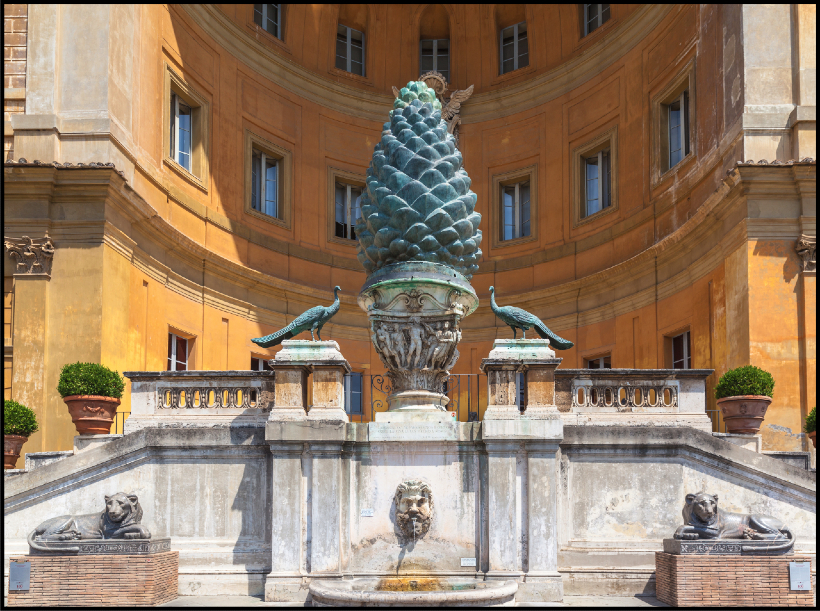
The photograph depicts a colossal pine cone in the Cortile della Pigna Courtyard of the Vatican, measuring an impressive four meters in height. Why would the Vatican, the sovereign state of the Catholic Church, erect such a statue? Furthermore, the Pope’s staff is adorned with a pine cone. What could these pine cones, seemingly harboring a profound secret, possibly symbolize? The answer lies within the human brain: the pineal gland.
“The pineal gland is the physical seat of the soul,” – Descartes
Indeed, from ancient times to the present, from shamanism to Catholicism (with the exception of Christianity), the pineal gland has been revered as a “spiritual gateway.” Often referred to as the “third eye,” this is not merely a metaphor. The pineal gland is composed of photoreceptor cells, similar to those found in the retina, making it sensitive to light. In Hinduism, the bindi on the forehead symbolizes the location of the pineal gland.
New Age philosophies often advocate for activating this “third eye” through meditation or substances like ayahuasca. Many ancient religions around the world have made similar claims, suggesting that awakening the pineal gland allows one to open the “spiritual eye” and connect with divine beings. Common tools for inducing such experiences include magic mushrooms, ayahuasca, and DMT. (However, the Christian Bible explicitly forbids humans from actively seeking spiritual beings.)
Conspiracy theorists often claim that fluoride in our water supply calcifies the pineal gland, inhibiting our spiritual abilities. However, this is an absolute disinformation.
Scientific research has revealed that the pineal gland plays a crucial role in producing serotonin, a neurotransmitter essential for mood regulation. It also produces DMT (dimethyltryptamine), a psychedelic substance that is thought to induce spiritual experiences. The reason we don’t normally experience these psychedelic effects is due to an enzyme called MAO (monoamine oxidase) produced by the pineal gland, which breaks down DMT.
Ayahuasca, a brew traditionally used by shamans in the Amazon rainforest and now gaining worldwide popularity, is a combination of plant-based substances that inhibit the MAO (monoamine oxidase) produced by the pineal gland, and DMT. Consequently, if the pineal gland is incapacitated, the human body will cease to produce MAO, leading to a high probability of encountering spiritual beings for 24 hours. (This can also be achieved through other methods such as inserting a cotton swab deep into the nose or receiving certain injections, which can potentially damage the pineal gland and lead to auditory and visual hallucinations as well as erratic behavior.)
Even without personal experience with ayahuasca, the validity of Descartes’ claim can be verified through extensive research conducted by organizations like National Geographic. Numerous studies have shown that the experiences induced by ayahuasca are not merely drug-induced hallucinations but genuine spiritual encounters. For instance, a female researcher who accompanied National Geographic to the Amazon and consumed ayahuasca described being trapped in a hellish abyss and being rescued by a local shaman who had also ingested the brew. Such shared experiences of encountering spiritual beings in otherworldly realms are quite common among ayahuasca users.
This suggests that the existence of a spiritual realm and spiritual beings is a scientifically verifiable fact. Those who claim that the spiritual realm or divine beings do not exist, simply because they believe in science, lack a comprehensive understanding. An analysis of ayahuasca experiences alone is sufficient to demonstrate that these experiences are real and not merely psychological or drug-induced hallucinations.
The question now becomes: Which deity or spiritual belief system should one follow? Catholicism and Buddhism, for example, are already incorporating ayahuasca into their practices, with adherents seeking encounters with the Virgin Mary or the Buddha. Hinduism is no exception. With the exception of those who adhere to a literal interpretation of the Bible, it seems that a world is emerging where anyone can encounter divine beings through ayahuasca. The recent legalization of ayahuasca for religious purposes in the United States has led to the proliferation of churches that use ayahuasca and psilocybin, substances not strictly adhered to by literal interpretations of the Bible. While this legalization may be controversial, it reflects a growing acceptance of individual freedom to explore spirituality. Ultimately, it is a matter of personal choice, with each individual bearing the consequences of their actions.
Leave a Reply