
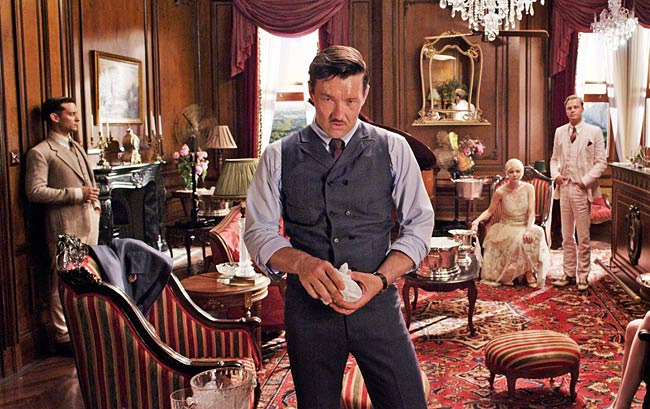
In The Great Gatsby, Gatsby, a man devoted to one woman, values something above all else, even risking everything for it in his final moments: he wants Daisy to say that she “never loved Tom.” Daisy, on the other hand, believes that the past doesn’t matter, that she loved them both, and that everything will be fine as long as she lives with Gatsby from now on. Meanwhile, Tom Buchanan, the capable man in charge of “dishwashing” (a metaphor for marrying someone who enjoyed a promiscuous sex life in their youth, when one has little to no dating experience, is an irrational choice, likening it to voluntarily washing dirty dishes left by others after they have finished eating.), takes the opportunity to launch personal attacks on Gatsby, calling him a vulgar loser. He tells Daisy that he may have affairs but always returns, implying that they should continue as they are. The unsaid message is: “That’s how everyone lives. Marriage is reality.”
Many female viewers might have had difficulty understanding Gatsby’s actions in this scene. Having finally won back Daisy, whom he had longed for so desperately, why does he insist on her confessing that she never loved Tom—as if everything depended on it—instead of simply running away with her? It’s understandable. Even Daisy couldn’t understand it. Why men are so fixated on a woman’s past.
But do they really not understand? Or has some self-defense mechanism caused their brains to sever the connections of understanding? Why do marriage agencies deduct points from a woman’s profile if she has work holiday or study abroad experience? Why is “slut” the worst insult for women, not “virgin”? Why did Gatsby, even though Daisy said she would live with him, insist that she say she “never loved Tom”? Can anyone truly, honestly say they have absolutely no idea?
The following is a poem written by a high-society woman who sold her body and soul to powerful men for greater success. (A poem never published to the world.
“Every day I wake with an aching heart, an ache like hell, as if something inside me has died and can never be restored. But I put on a smiling face anyway; it’s much easier that way. But if anyone asks me if I’m happy and I say yes, I can’t guarantee I’m telling the truth.
Life is now like a teabag to me, becoming only more bitter the longer it steeps. So, instead, I try to count the pleasures I’ve been given. I want to go home.”
This poem expresses the pain of someone who, due to their own greed and being deceived by someone, ruined something most important and realized it can never be restored. How bitter the memories must be that she tries to ignore everything and only count the pleasant things. Where is she that she misses home so much? She will continue to live like a pendulum, swinging between a bitter, teabag-like life and a life of only counting pleasures. The amplitude of the pendulum will grow larger and larger and probably won’t stop until the pendulum breaks. I hope she breaks the pendulum with her own hands, repents everything, turns back, and is reborn. Because I like people with bruised hearts.
However, for her to escape this vicious cycle and be reborn, she must look at herself more honestly and conscientiously. Everything that cannot be described publicly on social media should be considered a sin and repented. And she must never again create such unpublishable secrets. In that process, she must discard everything that needs to be discarded. Then, in that process, she will also realize that all past sexual relationships with men other than her husband are sins. What husband in the world can cast a stone at a woman who sincerely repents, acknowledging all past sexual relationships as sins and confessing that she was a disgusting sinner? If a woman does that, then all of the man’s past sexual relationships also become sins that must be repented, sins of violating women who should become someone’s wives.
If you don’t agree with this, I dare you to tell your husband all of your past. Tell him in detail and with confidence about your first experience: when, where, with whom, for how long, in what position, how it happened, how many different kinds of caresses and positions you’ve tried, how many sexual partners and encounters you’ve had to date, who was the best, where the most thrilling sex was, when you first experienced orgasm, who you experienced it with the most, who among your past boyfriends you loved the most, how many times you experienced internal ejaculation, etc. Prove that the past is not important in that way. Perhaps in about ten years, technology will emerge that can replay memories in your head like videos, so it would be good to watch those memories together in the marital bedroom. If you think they are just beautiful memories and not sins, then confidently do so.
In fact, sexual intercourse is like a gift from God that brings extremely personal and intimate pleasure that should only be managed and confined within the umbrella of marriage. It becomes poison if misused. (Dating, breakups, and crimes of passion all originate from sex.) The moment sex goes outside the umbrella of marriage, all that remains is pleasure, and the result is always tragic. I only realized that two years ago. Because no one taught me that. Even my parents only told me not to do it until I became an adult, and popular culture and friends only talked about it as something that would cause huge problems. But humans have an instinct that they can never build a harmonious and peaceful society in any form other than monogamy.
Looking at popular posts related to the “Dishwashing Theory” on several large online communities, the main points of contention can be summarized as follows:
- The fact that women spent their most brilliant days in their early 20s with men they don’t even know the faces or numbers of (but who are in the group photos at their weddings), sometimes passionately, sometimes affectionately, creating “beautiful memories.”
- The fact that they hide or lie about what “beautiful memories” they have specifically created to date.
- The fact that only after their 20s are over do they suddenly switch from free-sex mode to serious-sex mode, claiming they will now be serious. And then, in exchange for serious sex, the woman who used to have sex with a bottle of soju and a simple dish in her 20s begins to demand all sorts of things.
Upon encountering the “Dishwashing Theory,” I was both surprised and heartbroken. Surprised because many men were only now realizing facts that men who “play around” naturally knew, and heartbroken because I was actually confirming statistics that I had only known theoretically.
According to genetic analysis statistics, less than 50% of men who have existed historically have left descendants, while more than 80% of women have left descendants. And in the case of those who have left descendants, the average number of children is about 2.5 for men and about 1.5 for women. In other words, men in the top tier left more than two descendants with more than two women, while men in the bottom tier died without leaving even one descendant with a single woman.
Even in free democratic societies where monogamy is established, the situation doesn’t seem to have improved. Instead of having multiple wives at once, men like Trump have increased, replacing their wives every ten years and leaving six or more descendants. As a result, children growing up without fathers and men becoming obsolete have increased, and the world is becoming more and more of a mess.
One user on DC Inside’s stock gallery even argued for a “modern-day droit du seigneur” in a post related to the “Dishwashing Theory.” The content was that upper-class men with resources set up their own “castles of fantasy,” like in TV dramas, and invite women who turn twenty each year, giving them the feeling of becoming the main characters of dramas and providing them with “beautiful memories” while exercising droit du seigneur. When women who have spent their most beautiful years in the castle of fantasy are pushed out by other younger women, they can no longer meet men who can match their inflated expectations, so they either live in new towns relying on “dishwashing” men who are still capable of being seduced, while only reminiscing about beautiful memories, or they grow old without getting married. It was shocking. Based on my experience, the theory is mostly true.

But there is one thing that people don’t know. Most men would probably envy the men who live in those “castles of fantasy,” meeting different women in their early 20s every year, but speaking from the experience of having lived in the midst of it, perhaps the men who create those castles of fantasy themselves live the most empty lives. Women mostly leave that world, willingly or unwillingly, as they get older. Is that really unhappiness? Perhaps the people who continue to live in the world of fantasy should be more unhappy? Yet, feeling happiness without feeling unhappiness—isn’t that a kind of curse?
There’s the word “fetish.” People usually think of something perverted and suggestive, but if you look up the dictionary definition, it is as follows:
- Obsession
- Obtaining sexual pleasure through a specific object
- An object of worship
It’s easy to understand if you think of expressions like “-philia” that are commonly used these days. It’s interesting that it contains not only the stages of obsession and pleasure but also the meaning of religious worship. In the end, it means something that erodes from the physical (pleasure) to the spiritual (worship). Although it’s not written in the dictionary, one of the major characteristics of a fetish is pleasure that is beyond the defined purpose, scope, and degree.
For example, there are cases where people find greater pleasure from body parts like feet or armpits than from sex itself. One can feel some attraction to feet, but the purpose of feet is not originally for sexual activity. It can be called perverted. Applying it more broadly, homosexuality is also a kind of fetish, and incest or bestiality, which have the wrong address, also belong to fetishes, and disorganized orgies or swapping can also be said to be a type of fetish. And the pleasure felt from sexual activity outside the umbrella of marriage is also a fetish.
The characteristic of a fetish is that it is beyond the norm. When it goes beyond the norm, it naturally leads to strange side paths. You waver about where to go and gradually enter more bizarre paths. The problem is that you become addicted to the point where you cannot stop yourself. You need stronger and stronger stimuli and even cross over different types of fetishes. For example, some people say that liking extramarital affairs is a kind of fetish, so they feel much more pleasure from married men or women than from single people. Like this, a fetish, as a kind of idolatry of people pursuing pleasure beyond the norm, once you taste the unforgettable taste of the forbidden, you become unable to control yourself and become increasingly trapped in the unwanted snare of imagination. It can be said to be like a curse from God.
People who live in the castle of fantasy also live addicted to fetishes. People addicted to fetishes can pretend to be normal and good people, but they can’t become truly sound and conscientious people. Because unwanted imaginations constantly float in their heads, and depression and anxiety come. (Psychosis is the punishment that comes when conscience denies its existence.) The problem is that most people today live with one or more fetishes and idols.
Everyone must reflect on, repent, and negate their past selves. Married couples must sincerely repent if they have ever seen their partners not as soulmates but as objects of pleasure or economic and social tools. (I especially hope that capable but socially awkward men develop an eye for discerning mental and human charms such as thoughts and culture rather than women’s appearance. If you want to obsess over looks without dating experience, a private detective agency is essential.) All past sexual relationships must also be defined as sins and repented. Without these fundamental things, a person does not change. A person changes only when they repent to the point of feeling disgusted by their own past. Only then can they move away from the “dishwashing squad” or “empty bowls” mentioned in the “Dishwashing Theory.” Even if couples write agreements promising each other, “You will do this from now on, and I will do that,” and do that for a hundred years, people absolutely do not change. They only go up and down in a parabola, just staying in the same place. What if only I change and the other person remains the same? If the other person cheats, divorce is right, and if not, it’s better to be patient.
In the case of unmarried men, even if they feel like losers, they should never harbor resentment towards the world or others. You can think that now is the lowest point and harbor resentment toward the world, but if you do that, you will only experience a bottomless pit. A man is as good as dead without a noble goal. You can only live a meaningful life when you look towards a noble goal and take small actions that will help you day by day, when you become 1% better than yesterday every day. After all, there’s nothing else to do, is there? If you live a meaningful life, there is naturally a high possibility that you will one day enter the top tier. The castle of fantasy, the realm of the top 1%? It’s better not to even look at it. It’s a world of fetishes and a world of addicts.
P.S.
Some people argue that marriage was created as a tool of domination with the transition to agricultural society and may have been appropriate until the industrial era, but now it has fulfilled its historical mission. Some of them even mention the sexual culture of the Goryeo or Silla periods, which is presumed to have been free-spirited, and advocate for restoring the “group orgy festivals” of the Gojoseon nomads, our ancestors. (Interestingly, this overlaps with the sexual culture of the future society depicted by Aldous Huxley in his novel Brave New World. As if there were forces doing social engineering in that direction.)
People who say such things only come to their senses when they are shown the sight of their wives or daughters having group orgies with all the men in the neighborhood. Just like when someone who says, “There is no good or evil; everything is just a natural occurrence according to the law of survival of the fittest,” is tied up and has a couple of fingernails pulled out, and then a confession of faith bursts out, “These devils will be punished by heaven!” Why can’t they start the transition to the “open sexual culture” that they so strongly advocate for with their own families? That’s because they are not honest with themselves or their conscience is broken. Because their conscience is broken, it’s “as long as it’s not me.”
Leave a Reply